Search Engine Optimization Tips Most Guides Skip: Publishing Cadence, Not Just On-Page Tricks
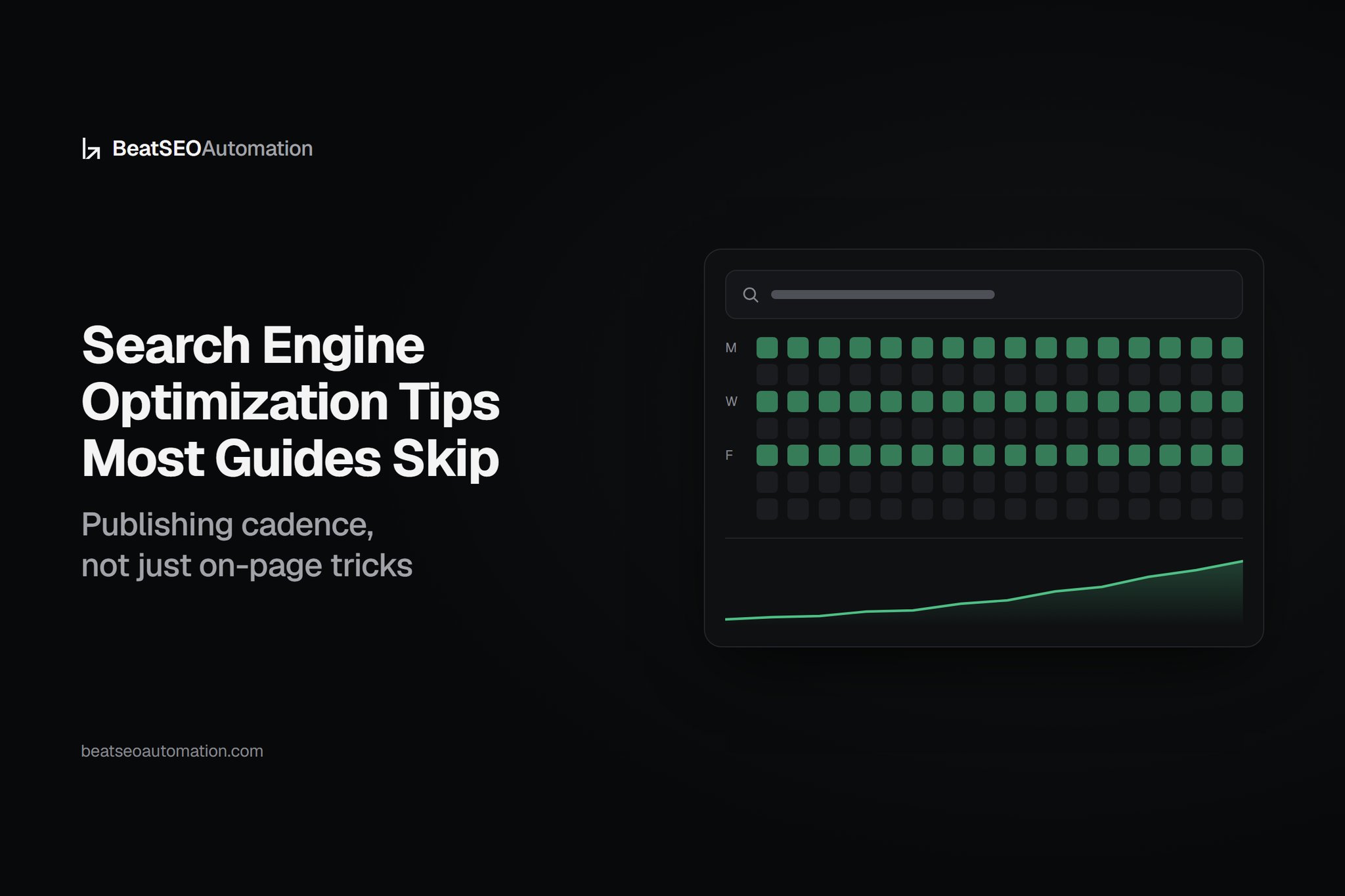
The most effective search engine optimization tips right now aren't about title tags or alt text — they're about consistency. Publishing on a fixed cadence, covering a topic completely instead of chasing single keywords, and systematically refreshing old posts do more for rankings over time than another round of on-page tweaks.
That's not what most "tips" articles tell you. Search any variation of search engine optimization tips and you'll get the same dozen bullet points: write good title tags, use header tags, get backlinks, improve page speed. All true. All table stakes. Everyone ranking against you has already done them, which is exactly why that list has stopped moving the needle for most sites.
Why Most Search Engine Optimization Tips Plateau
On-page checklist items are one-time fixes. You optimize a title tag once and move on. But Google's ranking systems increasingly reward sites that demonstrate ongoing relevance and depth on a subject, not just a well-formatted page. According to Ahrefs' study of over a billion web pages, 96.55% of pages get zero organic traffic from Google — and a large share of those are pages published once, on a single keyword, and never touched again. The checklist tips don't fail because they're wrong; they fail because they're treated as a finish line instead of a starting point.
The Search Engine Optimization Tips Guides Actually Skip
1. Publish on a Fixed Cadence, Not in Bursts
A burst of ten posts followed by three months of silence signals inconsistency to both readers and search engines. A steady, predictable cadence — weekly, biweekly, whatever you can sustain — builds a crawl and indexing pattern that favors your site. HubSpot's long-running research on blogging frequency has consistently found that companies publishing more often see meaningfully stronger traffic growth than infrequent publishers. Cadence, not volume in one sitting, is the compounding lever.
2. Cover Topics Completely, Not Keywords Individually
Ranking for one keyword rarely builds authority. A SaaS company that publishes a "pricing" page but ignores "implementation," "integrations," and "vs. competitor" comparisons leaves the topic cluster wide open for someone else to own. We've written more on this in our piece on topical authority and daily content engines — the short version is that complete coverage of a subject earns trust signals a single optimized page never will.
3. Refresh and Re-Index Old Posts Systematically
A post that ranked well a year ago can quietly lose ground as competitors update theirs and search intent shifts. Google has said freshness is a factor it evaluates for queries where recency matters, which is exactly why a scheduled refresh cycle — not just new publishing — belongs in your process.
4. Write Answer-Shaped Intros for AI Overviews
AI Overviews and chat-based answer engines pull from content that states a direct answer in the first sentence or two, before any preamble. If your intros bury the answer under three paragraphs of context, you're invisible to citation — regardless of how well the page ranks traditionally. This article's own opening line is built on that principle: state the answer first, explain it after.
5. Track Leading KPIs, Not Just Rankings
Rankings lag. Indexation rate, click-through on new posts, and citation appearances are leading indicators that tell you something is working weeks before rank trackers catch up. Our breakdown of the SEO KPIs that actually predict revenue goes deeper on which numbers to watch first.
Turning Tips Into a System
Any one of these tips is a good habit. Together, they're a system — and systems are hard to run manually alongside everything else a business already has to do. If you've read our 12 practical SEO tips you can ship this week, think of this article as the next layer: the operating rhythm that makes those tactics compound instead of expire.
Turn these tips into a running system — we publish daily so you don't have to. Request a quote.
Frequently asked questions
What are the most important search engine optimization tips that most guides leave out?
Publishing on a fixed cadence, covering a topic completely rather than one keyword at a time, and systematically refreshing older posts — these compound over time in a way that one-time on-page fixes like title tags never do.
How often should I publish content for SEO results?
There's no single universal number, but research on blogging frequency from HubSpot has consistently found that companies publishing on a regular schedule (weekly or biweekly) see stronger traffic growth than those publishing in sporadic bursts.
Do these SEO tips work for small businesses without a marketing team?
Yes — the tips center on process (cadence, coverage, refresh cycles) rather than technical expertise, which makes them achievable even without an in-house SEO specialist, especially with a done-for-you content service handling the research and drafting.
How is refreshing old content different from just publishing new posts?
Refreshing means systematically updating existing pages with new information, sources, or structure to recapture rankings and freshness signals, while new posts expand topic coverage — a compounding content strategy needs both.
How do I get my content cited in AI Overviews and chat-based search tools?
State the direct answer to the reader's question in the first sentence or two, before any preamble, since AI Overviews and answer engines weight the opening of a page most heavily when selecting quotable content.